Ship direct to you $25 Perth Metro

Why On-Board Air Makes Sense for Perth 4WD Owners
If you spend real time using a 4WD around Perth, you already know how often tyre pressures need to change. You air down for sand, rough tracks, or corrugations, then air back up before the highway run home. ARB describes 4WD compressors as useful for quickly adjusting tyre pressures to suit changing terrain, and Isuzu UTE Australia’s sand-driving guidance specifically recommends dropping tyre pressures for soft sand to improve footprint and flotation. For Perth owners moving between coastal sand and sealed roads, a fixed on-board air compressor is one of those upgrades that saves time almost every trip.
That is where a hard-mounted on-board air compressor built around the Oricom AIR40 starts to make sense. Official Oricom figures put the AIR40 at 130 L/min at 0 PSI, 108 L/min at 40 PSI, 150 PSI max working pressure, and 62A draw under load, with twin 40 mm cylinders, washable filters, thermal protection, a 6 m hose, and a 3-year warranty. In plain English, that gives a Perth workshop a credible twin-cylinder compressor for wagons, dual-cab utes, and overland builds that want faster air-up times than entry-level portables without jumping straight into the highest-priced premium twins.
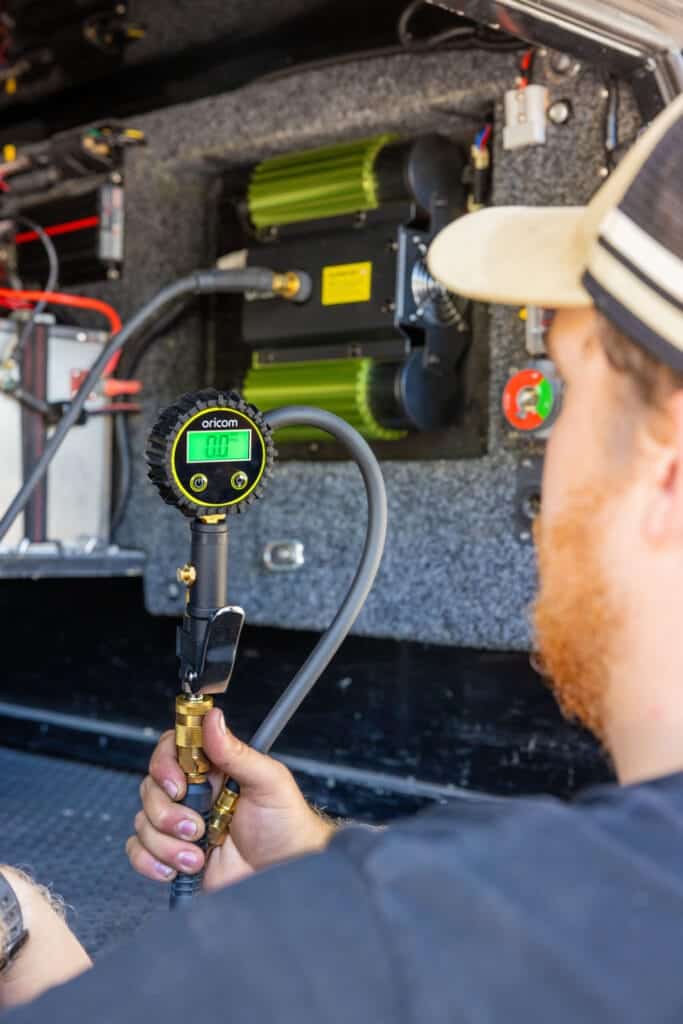
Faster, more disciplined tyre inflation
The most obvious benefit of an on-board air compressor is tyre inflation. A good on-board air system makes it easier to return from low-pressure track or beach settings to safe road pressures, and it also encourages drivers to be more disciplined about pressure changes in the first place. That matters for traction, ride, and drivability. It is also why tyre inflators, deflators, and pressure-management accessories are such a major part of the Australian 4WD compressor market: the real value is not only “having air,” but having air that is quick and convenient enough that you actually use it properly.
More than a tyre pump
The next step up is utility beyond simple tyre inflation. ARB says its on-board twin compressor is suitable for many air tools when paired with an optional 4L tank, and TJM’s Pro Series Twin is built around multiple accessory ports and optional 2.5L or 5L tanks. That matters because an on-board air compressor is often part of a broader touring, trade, or recovery-focused setup. It can support short bursts of compatible air-tool use, make hose access easier for field repairs, and pair well with air lockers or future accessory planning. It is still not a substitute for a full workshop compressor, but it can absolutely be more than just a tyre pump when the system is designed properly. If you’re still weighing up which unit suits your build, it’s worth browsing the range of on-board air systems before locking anything in.
Plan the install once, not twice
Suspension planning is another reason many owners choose to install on-board air properly the first time. ARB’s air suspension control module is designed to integrate with a range of ARB compressors, and Air On Board sells complete compressor-and-tank systems with air bag controllers. That does not mean every AIR40 install should be sold as an air suspension job, but it does mean a good Perth workshop can ask the right question early: do you only want faster tyre inflation now, or do you also want the install laid out so tanks, extra outlets, or pneumatic accessories can be added later? That kind of planning is where a permanent install becomes far more valuable than a portable bag kept behind the rear seat.
Where a specialist install stands apart
Installation quality is also where a specialist workshop can genuinely stand apart. Oricom’s AIR40 guide says the compressor should be mounted vertically in a stable, dry location with clearance for the filters and fan housings, away from heat sources and submersion risk. In the broader Australian market, brackets are highly vehicle-specific: there are off-the-shelf options for engine-bay, under-seat, under-tub, and rear-cabin locations depending on the vehicle. That is why custom or vehicle-specific bracket work matters. A good mount improves serviceability, protects the compressor from vibration and heat issues, and makes the finished system feel integrated rather than added on. A professional on-board air installation in Perth is what turns a good compressor into a system you can rely on.
Maintenance matters in the WA heat
Maintenance is the final piece, and it matters in WA. Oricom’s guide says higher temperatures reduce operating time before the compressor must rest, while Perth’s long-term January and February mean maximum temperatures sit above 31°C. The same guide calls for periodic filter cleaning, post-use inspection of the hose and cables, and corrosion checks at the battery. If a tank is fitted, Oricom also recommends moisture management with a trap and/or drain valve. In other words, Perth conditions reward tidy installation, good airflow, clean intake placement, and sensible servicing habits. A well-installed on-board air compressor should feel simple to use, but it should never be treated as maintenance-free.
Taken together, that is the real case for this service page. Perth 4WD owners are not just buying a compressor; they are buying faster transitions, cleaner fitment, and less hassle every time the trip moves from sand or dirt back to bitumen. Framed that way, an AIR40-based on-board air compressor installation becomes a practical upgrade for beach drivers, tourers, tradespeople, and overlanders alike.